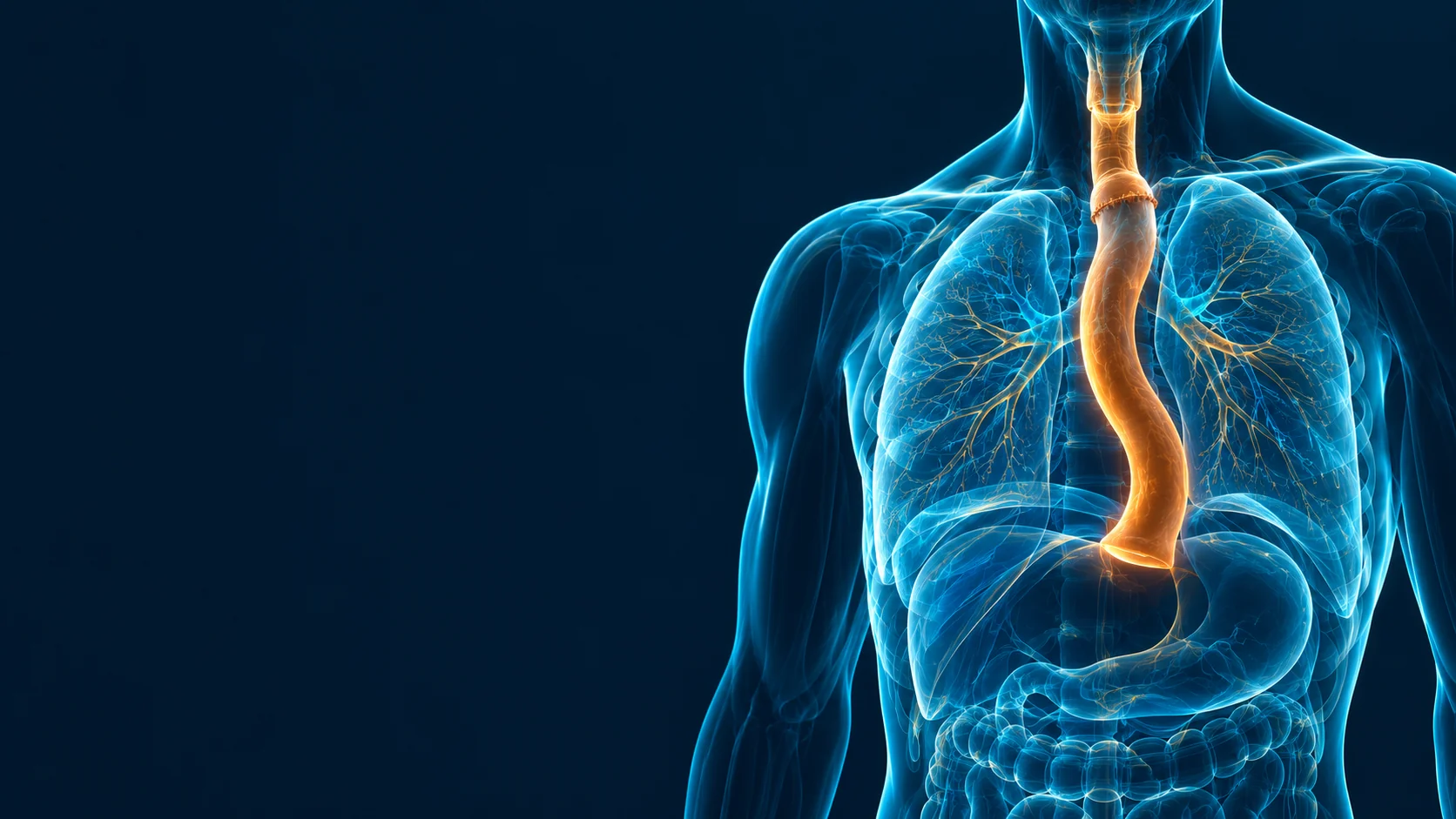
When I talk to a patient about esophagectomy, the conversation is mostly about cure. That is the goal, and for many people it is achievable. But I also make a point of talking about life after the operation, because I would rather you hear it from me now than discover it on your own later. This is a major operation that brings a permanent change in lifestyle. Knowing what to expect, and why, is the best way to prepare for it.
What the operation changes
During an esophagectomy, the cancer-bearing esophagus is removed and the stomach is reshaped into a narrow tube, called a conduit, which is brought up into the chest and joined to the remaining esophagus. It is a remarkable reconstruction, but it is not the same as what nature gave you, and three changes explain most of what patients feel afterwards:
- The valve is gone. The lower esophageal sphincter, the muscle that normally stops stomach contents from coming back up, is removed with the operation. Nothing now holds acid and food in the stomach.
- The stomach is smaller and sits in the chest. A tube-shaped stomach holds less, so you feel full sooner.
- The stomach empties more slowly. The vagus nerves that help the stomach contract and empty are divided during the operation, so food can sit in the conduit longer than it used to.
Reflux, and why acid suppression is lifelong
Reflux is one of the most common long-term problems after esophagectomy, affecting roughly a quarter to well over a third of patients in published series.2,3 Heartburn is unpleasant, but my bigger concern is your lungs. Without a valve, stomach contents (acid, bile and food) can travel back up and spill into the airway, especially when you lie flat. This is called aspiration. It can cause inflammation of the lungs (pneumonitis) and aspiration pneumonia.3 Over time, repeated small episodes of aspiration are associated with ongoing lung injury and scarring (pulmonary fibrosis).4
For this reason I recommend that patients stay on acid-suppressing medication, usually a proton pump inhibitor (PPI), for the rest of their lives. Taking PPIs routinely after esophagectomy is supported in the literature as a way to relieve and prevent reflux symptoms.2 One point is important to understand: a PPI makes what comes back up less acidic, but it does not stop things from coming back up. That is why medication alone is not enough. How you sleep and how you eat matter just as much.
Sleeping on a slight incline
Gravity is your friend after an esophagectomy. I ask every patient to sleep with the whole bed slightly tilted, head end up. The simplest way to do this is something I tell patients all the time: put two planks of wood or sturdy bed risers under the legs at the head of your bed, raising it about 15–20 cm (6–8 inches). This creates a gentle slope from head to toe.
Raising the head of the bed is a recognized measure for night-time reflux,6 and a randomized trial using 20 cm risers found that more patients improved with elevation than without it.5 Stacking pillows is not the same thing: it bends you at the waist and can push stomach contents upward. A firm foam wedge under the mattress is a reasonable alternative. Some people find the slope takes a few nights to get used to.
Equally important: don’t eat for at least 2–3 hours before lying down, so the conduit has time to empty before you go to bed.
Smaller meals, and feeling full sooner
With a smaller stomach, large meals are no longer comfortable. Most patients feel full after just a few mouthfuls at first. The answer is to change how you eat rather than what you eat:
- Eat six small meals or snacks a day instead of three large meals.
- Eat slowly and chew well. Stop when you first feel full.
- Sip fluids between meals rather than drinking a lot with them, which fills the conduit quickly.
- Stay upright (sitting or walking) for at least 30–60 minutes after eating, and avoid bending over soon after a meal.
Weight loss and nutrition
Almost everyone loses weight after esophagectomy, and it is better to expect it than to be alarmed by it. A systematic review found typical weight loss of 5–12% at six months after surgery, with more than half of patients losing more than 10% of their body weight by one year. Many never return fully to their pre-operative weight.7
That is why nutrition is part of the plan from day one. Some patients go home with a small temporary feeding tube to top up calories while eating settles. Seeing a registered dietitian, choosing energy- and protein-dense foods, and weighing yourself regularly all help. If your weight keeps dropping, tell your team early; it is far easier to correct sooner than later. Nutritional problems are also one of the treatable factors behind the minority of patients whose quality of life stays low years after surgery.1
Slow emptying (gastroparesis) of the conduit
Because the vagus nerves are divided, the new stomach often empties slowly. Doctors call this delayed gastric conduit emptying, a form of gastroparesis. Food sits in the conduit longer, and you may feel bloated, overly full, nauseated, or bring food back up. Some degree of symptoms is very common, and about 10–20% of patients have clinically important delayed emptying.8
The good news is that there are effective options, chosen according to the cause:8
- Medications that help the stomach empty (prokinetics such as erythromycin or metoclopramide), used under medical supervision.
- Treating the pylorus, the muscular outlet at the bottom of the conduit, through an endoscope: a Botox injection to relax it, or balloon dilation to stretch it open.
- Diet changes, such as smaller, softer and lower-fat meals that leave the stomach more easily.
When the conduit changes over time
Over the years, the conduit can gradually stretch and become redundant: longer, baggier and sagging, so that food pools instead of flowing through. When this happens, the fullness, bloating and regurgitation that patients had learned to manage can slowly get worse. The size and shape of the conduit are known to affect how well it empties.8 If symptoms change years after surgery, they deserve a fresh look, usually with a contrast swallow study or an endoscopy. Most patients are managed with the measures above, and in selected cases surgical revision of the conduit is an option.
The hopeful part
None of this is meant to discourage you. A large prospective study that followed esophagectomy survivors for five years found that most had a quality of life comparable to the general population. About one in six had lasting difficulties, and the authors stressed that these patients can be identified and helped with targeted support such as nutritional care.1 Quality-of-life studies have also found that minimally invasive esophagectomy is associated with better quality of life in some areas in the months after surgery, compared with the open operation.9
In my experience, the patients who do best are the ones who understand the “why” behind each habit and make it part of their routine.
My everyday rules after esophagectomy
- Take your acid suppressant every day, for life, unless your surgeon tells you otherwise.
- Raise the head of the bed 15–20 cm with blocks or planks under the legs.
- Stop eating 2–3 hours before bed.
- Eat small and often, slowly, and sip fluids between meals.
- Stay upright after eating, and avoid bending over soon after meals.
- Watch your weight, and keep in touch with your dietitian.
You can read more about the operation itself on the esophageal cancer page and in the recovery guide for minimally invasive esophagectomy. To learn about the reflux-to-cancer pathway, see From reflux to esophageal cancer.
Common questions
Do I need to take acid medication for the rest of my life after esophagectomy?
How should I raise my bed after esophagectomy?
Why do I feel full so quickly after an esophagectomy?
Will I lose weight after esophagectomy?

References
- Derogar M, Lagergren P. Health-related quality of life among 5-year survivors of esophageal cancer surgery: a prospective population-based study. J Clin Oncol. 2012;30(4):413–418.
- Lisboa EN, Sunye IR, Aranha GL, et al. Gastroesophageal reflux disease after esophagectomy—a narrative review. Dig Med Res. 2024;7:10.
- Park S, Kang CH, Lee HJ, Park IK, Kim YT. Prevalence and risk factors of reflux after esophagectomy for esophageal cancer. J Thorac Dis. 2020;12(3):558–567.
- Fahim A, Crooks M, Hart SP. Gastroesophageal reflux and idiopathic pulmonary fibrosis: a review. Pulm Med. 2011;2011:634613.
- Villamil Morales IM, Gallego Ospina DM, Otero Regino WA. Impact of head of bed elevation in symptoms of patients with gastroesophageal reflux disease: a randomized single-blind study (IBELGA). Gastroenterol Hepatol. 2020;43(6):310–321.
- Katz PO, Dunbar KB, Schnoll-Sussman FH, Greer KB, Yadlapati R, Spechler SJ. ACG Clinical Guideline for the Diagnosis and Management of Gastroesophageal Reflux Disease. Am J Gastroenterol. 2022;117(1):27–56.
- Baker M, Halliday V, Williams RN, Bowrey DJ. A systematic review of the nutritional consequences of esophagectomy. Clin Nutr. 2016;35(5):987–994.
- Konradsson M, Nilsson M. Delayed emptying of the gastric conduit after esophagectomy. J Thorac Dis. 2019;11(Suppl 5):S835–S844.
- Kauppila JH, Xie S, Johar A, Markar SR, Lagergren P. Meta-analysis of health-related quality of life after minimally invasive versus open oesophagectomy for oesophageal cancer. Br J Surg. 2017;104(9):1131–1140.