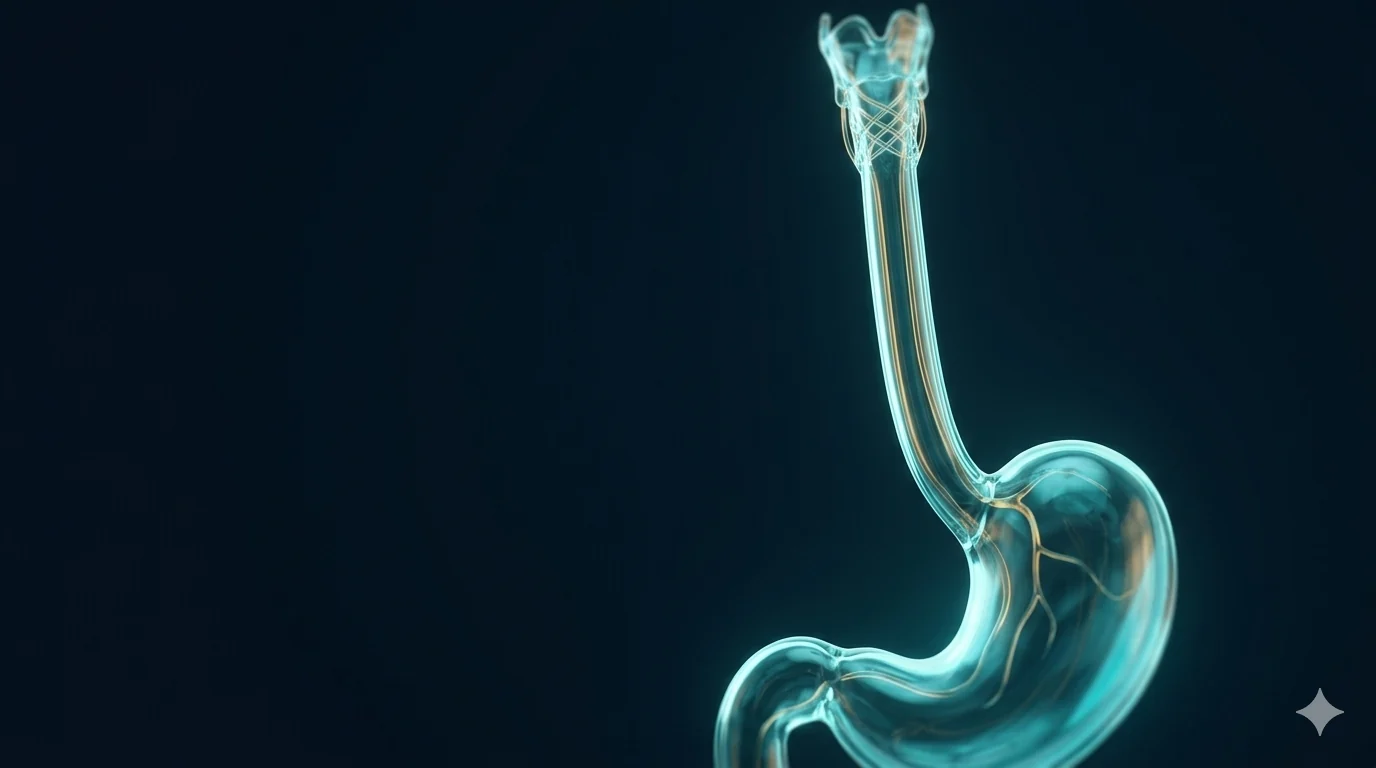
In achalasia, the valve at the bottom of the esophagus (the lower esophageal sphincter) doesn’t relax when you swallow, and the esophagus loses its ability to push food down. Food and liquid back up, and swallowing becomes a daily struggle. No treatment restores the lost muscle function. What treatment can do is open the valve so gravity can do the work. The question patients most often ask me is which way of opening it is right for them. Here is how I weigh the four main options when I see patients from Toronto and across the GTA at William Osler Health System.
The four treatments, briefly
Heller myotomy
Keyhole surgery · general anaestheticThrough a few small incisions in the upper abdomen, I divide the muscle layers of the lower esophagus and the top of the stomach, leaving the inner lining intact. I then add a partial wrap of stomach (a Dor or Toupet fundoplication) to limit reflux.
- Most patients go home within about 24 hours
- A one-time operation
POEM
Endoscopic · general anaestheticAn endoscope is passed through the mouth. A small opening is made in the inner lining of the esophagus, a tunnel is created beneath it, and the muscle is cut from the inside. The opening is then closed with clips.
- No skin incisions; usually one night in hospital
- No anti-reflux wrap is added
Balloon (pneumatic) dilation
Endoscopic · sedationA balloon is positioned across the valve and inflated to forcefully stretch and tear the tight muscle. It is often done as a series, with a larger balloon if symptoms return.
- Day procedure, no incisions
- Not permanent — relief can fade, so repeat dilations are often needed; small risk of perforation
Botox injection
Endoscopic · sedationBotulinum toxin is injected into the valve muscle during a short endoscopy. It blocks the nerve signals that keep the muscle tight, so the valve relaxes for a while.
- Day procedure, quickest recovery
- Only lasts a few months; must be repeated
The four options, side by side
| What matters to patients | Heller myotomykeyhole surgery + partial wrap | POEMendoscopic myotomy | Balloon dilationendoscopic stretching | Botoxendoscopic injection |
|---|---|---|---|---|
| Long-term relief of swallowing symptoms | ✓ | ✓ | ~ | ✗ |
| Five or more years of randomized-trial evidence | ✓ | ✓ | ✓ | ✗ |
| Anti-reflux valve (fundoplication) added at the same time | ✓ | ✗ | ✗ | ✗ |
| Lower chance of reflux afterwards | ✓ | ✗ | ✓ | ✓ |
| Surgeon directly sees the whole muscle, including the stomach side | ✓ | ~ | ✗ | ✗ |
| Any injury seen and repaired straight away, under direct vision | ✓ | ~ | ✗ | ✗ |
| No skin incisions | ✗ | ✓ | ✓ | ✓ |
| Home within about 24 hours | ✓ | ✓ | ✓ | ✓ |
| Avoids a general anaesthetic | ✗ | ✗ | ✓ | ✓ |
| Suited to frail or high-risk patients | ~ | ~ | ✗ | ✓ |
| Usually a one-time treatment | ✓ | ✓ | ✗ | ✗ |
This is a simplified summary to help you have the conversation, not a substitute for it. The right choice depends on your achalasia type, your anatomy, previous treatments and your overall health.
Heller myotomy: why I still favour it for most patients
In experienced hands, a laparoscopic Heller myotomy is a relatively quick operation, and most people go home within about 24 hours. Some centres send selected patients home the same day.8 Its results have been studied for decades, they are durable, and it has long been regarded as the surgical gold standard. Here is why it remains my preference for most people who are fit for surgery.
- I can see the whole muscle. Working from the outside, I directly see and divide every fibre of the tight muscle, and I confirm nothing is left behind. That includes the muscle on the stomach side of the valve, which must be cut for at least 2–3 cm onto the stomach. An incomplete myotomy, especially on the stomach side, is a recognized cause of symptoms that persist or come back after treatment.6
- I can prevent reflux in the same operation. Once the valve is opened, stomach acid can flow back up freely, and the resulting reflux can be severe. During a Heller myotomy I add a partial fundoplication, a loose wrap of stomach that acts as a gentle anti-reflux valve. In a randomized trial, abnormal reflux after Heller myotomy fell from 47.6% without the wrap to 9.1% with it.3 The ACG guideline recommends adding a fundoplication to surgical myotomy.5
- Everything happens under direct vision. If the lining of the esophagus is nicked while dividing the muscle, I see it and repair it on the spot.
- The results last. In one randomized trial, 87.5% of patients were symptom-free two years after Heller myotomy.4
POEM: a genuinely good option, with a trade-off
POEM (peroral endoscopic myotomy) cuts the same muscle as a Heller myotomy, but from the inside and without skin incisions, and it relieves swallowing symptoms very effectively. In the largest randomized trial comparing it with Heller myotomy, the two worked about equally well: 83.0% versus 81.7% success at two years,1 and 75.0% versus 70.8% at five years.2 Serious complications were uncommon with both.
The trade-off is reflux. Because POEM doesn’t add an anti-reflux wrap, inflammation from acid reflux (reflux esophagitis) is more common afterwards. In that trial, it was found in 44% of POEM patients versus 29% after Heller myotomy at two years.1 At five years the figures were 41% versus 31%.2 A separate study that scoped patients more than five years after POEM found reflux esophagitis in 41.6%, and about a third of those cases were severe.7 The ACG guideline notes that some patients may need acid-suppressing medication for life after POEM.5 For some patients POEM is the right choice. I just want everyone to understand this trade-off before choosing it.
Balloon dilation: effective, but often needs repeating
Balloon dilation works well. In the large European Achalasia Trial, dilation and Heller myotomy gave similar success at two years (86% versus 90%)9 and at five years (82% versus 84%).10 About a quarter of dilation patients needed their dilation repeated along the way,10 and reflux was no more common than after surgery.9
There are two drawbacks. First, the tear is made blind, from the inside, so nobody can check how completely the muscle has been divided. Second, the esophagus was torn right through (perforated) in 4% of patients in that trial.9 A perforation is serious and can need an operation, which is why dilation is generally offered to people who would be fit for surgery if one happened. When dilation was compared directly with POEM, it held up less well without further treatment: 54% versus 92% success at two years,11 and 40% versus 81% at five years.12
Botox: a bridge, not a cure
Botox is the simplest option, with no incisions and no general anaesthetic. The catch is that it only lasts a few months, so it has to be repeated — and, as with balloon dilation, the valve tightens again over time. In pooled data, the proportion of patients with symptom relief fell from about 70% at three months to about 41% at one year.5 In a randomized trial against Heller myotomy, only 34% of Botox patients were symptom-free at two years, compared with 87.5% after surgery.4 That is why the ACG guideline recommends Botox mainly for people who aren’t fit for a myotomy or dilation.5 For them it can be a very reasonable choice.
Common questions
Is POEM better than Heller myotomy for achalasia?
Is balloon dilation a good option for achalasia?
How long does Botox last for achalasia?
Will I get reflux after achalasia treatment?
How long will I be in hospital after a Heller myotomy?
References
- Werner YB, Hakanson B, Martinek J, et al. Endoscopic or surgical myotomy in patients with idiopathic achalasia. N Engl J Med. 2019;381(23):2219–2229.
- Hugova K, et al. Per-oral endoscopic myotomy versus laparoscopic Heller’s myotomy plus Dor fundoplication in patients with idiopathic achalasia: 5-year follow-up of a multicentre, randomised, open-label, non-inferiority trial. Lancet Gastroenterol Hepatol. 2025;10:431–441.
- Richards WO, Torquati A, Holzman MD, et al. Heller myotomy versus Heller myotomy with Dor fundoplication for achalasia: a prospective randomized double-blind clinical trial. Ann Surg. 2004;240(3):405–412.
- Zaninotto G, Annese V, Costantini M, et al. Randomized controlled trial of botulinum toxin versus laparoscopic Heller myotomy for esophageal achalasia. Ann Surg. 2004;239(3):364–370.
- Vaezi MF, Pandolfino JE, Yadlapati RH, et al. ACG clinical guidelines: diagnosis and management of achalasia. Am J Gastroenterol. 2020;115(9):1393–1411.
- Turner RC, Nguyen AD, et al. Management of recurrent dysphagia after POEM and Heller myotomy: current strategies and future directions. Curr Gastroenterol Rep. 2026;28:9.
- Wessels EM, Masclee GMC, et al. Long-term outcomes of peroral endoscopic myotomy (POEM): reflux esophagitis and complications including Barrett esophagus and peptic strictures. Dis Esophagus. 2026;39(4):doag086.
- Al Jabri, et al. Same-day discharge for laparoscopic Heller myotomy. Surg Endosc. 2022;36:6255–6259.
- Boeckxstaens GE, Annese V, des Varannes SB, et al. Pneumatic dilation versus laparoscopic Heller’s myotomy for idiopathic achalasia. N Engl J Med. 2011;364(19):1807–1816.
- Moonen A, Annese V, Belmans A, et al. Long-term results of the European achalasia trial: a multicentre randomised controlled trial comparing pneumatic dilation versus laparoscopic Heller myotomy. Gut. 2016;65(5):732–739.
- Ponds FA, Fockens P, et al. Effect of peroral endoscopic myotomy vs pneumatic dilation on symptom severity and treatment outcomes among treatment-naive patients with achalasia: a randomized clinical trial. JAMA. 2019;322(2):134–144.
- Kuipers T, Ponds FA, Fockens P, et al. Peroral endoscopic myotomy versus pneumatic dilation in treatment-naive patients with achalasia: 5-year follow-up of a randomised controlled trial. Lancet Gastroenterol Hepatol. 2022;7:1103–1111.