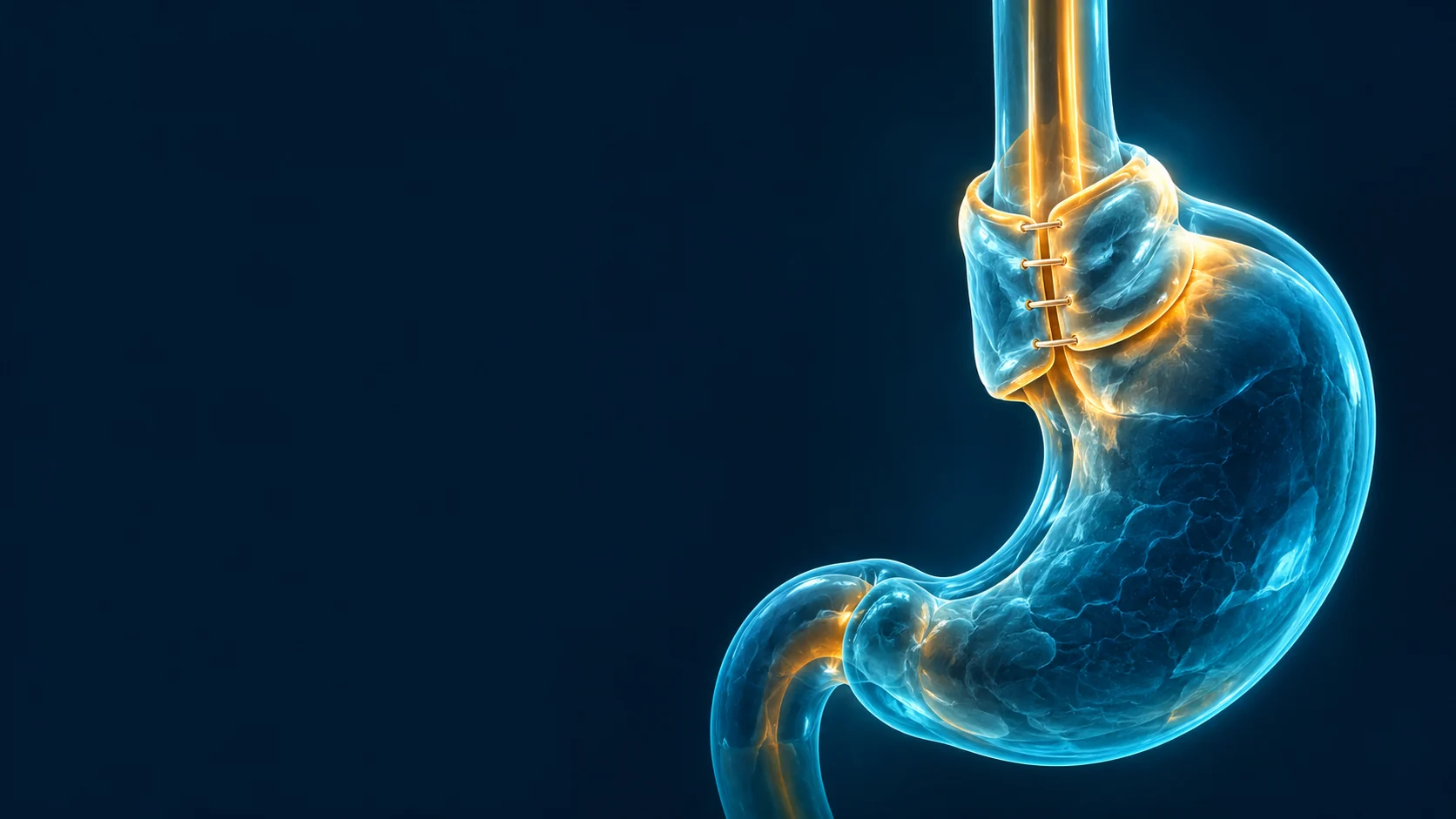
When I recommend anti-reflux surgery, one of the most common questions is “Which wrap will you do?” Every fundoplication rebuilds the valve at the bottom of the esophagus by wrapping the top of the stomach (the fundus) around it. The real question is how far around, and that is a decision I tailor to each patient.
The three wraps at a glance
| Nissenfull wrap | Toupetpartial wrap | Dorpartial wrap | |
|---|---|---|---|
| How far around | 360° | 270° | 180° |
| Position | All the way around | Behind the esophagus | In front of the esophagus |
| Reflux control | Strongest | Good | Good |
| Swallowing & bloating | More early tightness and bloating | Gentler | Gentler |
| When I tend to use it | Heartburn-predominant, good motility | Swallowing trouble or bloating, weak motility | Swallowing trouble or bloating, weak motility |
Step one: what are your symptoms?
Before any operation, I ask every patient in detail about their symptoms, because they tell me a lot about which wrap will serve them best.
- Mostly severe heartburn: if reflux is the dominant problem, I want to do a true anti-reflux operation, which is a full “floppy” Nissen fundoplication. “Floppy” means the wrap is made deliberately short and loose, so it stops acid from coming up without squeezing food on the way down.
- Mostly difficulty getting food down, or bloating: if swallowing trouble (dysphagia) or bloating is a big part of the picture, I lean towards a partial wrap, either a Toupet or a Dor. A partial wrap still controls reflux but puts less of a squeeze on the lower esophagus, so it is less likely to make those symptoms worse.
Step two: how well does your esophagus move food down?
The esophagus is not just a tube. It pushes food down in a coordinated wave, and how strong that wave is (its motility) matters when choosing a wrap.
The most precise test of motility is esophageal manometry, and I try to get one for my patients. In Canada, though, the wait for manometry can be long. When it isn’t available in time, I rely on the barium swallow. It is a dynamic test: we watch, in real time on X-ray, how the esophagus carries the barium down, which gives a good picture of how well it is working.
- Very poor motility, or no effective wave at all (aperistalsis): the esophagus can’t push hard against resistance, so I want to keep any obstruction at the junction with the stomach to a minimum. That means a partial wrap.
- Excellent motility: the esophagus can easily push food through a full wrap, so I am more inclined to do a Nissen.
Putting your symptoms and your motility together is how I arrive at the right wrap for you, rather than using the same operation for everyone.
One thing I do with every wrap
Whichever wrap I use, I always stitch it to the diaphragm at the opening it passes through (the hiatus). Anchoring the wrap to the hiatus in this way (a “pexy”) keeps it in the correct spot and stops it from migrating up into the chest in the future, one of the ways a repair can fail over time. You can read more about this in Why do hiatus hernias come back?
What the evidence says
- Nissen vs Toupet: a combined analysis of seven randomized trials, with nearly 800 patients, found that reflux control was similar with both wraps. The Toupet led to less trouble swallowing, fewer stretching procedures (dilations), less gas-bloat, an easier time burping and fewer reoperations.1
- Guidelines: the 2021 guideline from the Society of American Gastrointestinal and Endoscopic Surgeons (SAGES) supports either a full or a partial wrap, chosen around what matters most to the patient. A full wrap may be preferred when reflux control is the priority, and a partial wrap when avoiding swallowing difficulty matters most.2
- Dor vs Toupet: both partial wraps are commonly added after a Heller myotomy for achalasia. In a multicentre randomized trial, both gave similar improvements in swallowing and regurgitation, with no significant difference in reflux on pH testing.3 Adding a partial wrap after Heller myotomy greatly reduces reflux compared with no wrap.4
What to expect after surgery
With any wrap, some tightness when swallowing is common in the first few weeks while the swelling settles, which is why you start on a liquid and then soft diet. Burping and vomiting are harder at first, especially after a full Nissen, and some bloating is normal early on; most people adapt over time. The recovery guide covers the diet and activity plan week by week, and the possible complications are on the risks page.
For a step-by-step look at the whole operation, read Keyhole hiatal hernia surgery and fundoplication: what actually happens, take the reflux self-assessment, or see my detailed approach in Dr. Irshad’s Take.
Common questions
Which is better, a Nissen or a Toupet fundoplication?
What is a floppy Nissen?
When is a Dor fundoplication used?
Do I need a manometry test before fundoplication?
Can a fundoplication wrap slip after surgery?

References
- Broeders JA, Mauritz FA, Ahmed Ali U, et al. Systematic review and meta-analysis of laparoscopic Nissen (posterior total) versus Toupet (posterior partial) fundoplication for gastro-oesophageal reflux disease. Br J Surg. 2010;97(9):1318–1330.
- Slater BJ, Dirks RC, McKinley SK, et al. SAGES guidelines for the surgical treatment of gastroesophageal reflux (GERD). Surg Endosc. 2021;35(9):4903–4917.
- Rawlings A, Soper NJ, Oelschlager B, et al. Laparoscopic Dor versus Toupet fundoplication following Heller myotomy for achalasia: results of a multicenter, prospective, randomized-controlled trial. Surg Endosc. 2012;26(1):18–26.
- Campos GM, Vittinghoff E, Rabl C, et al. Endoscopic and surgical treatments for achalasia: a systematic review and meta-analysis. Ann Surg. 2009;249(1):45–57.